TECTONIC
27, 29, 30, 31 January 2026, Dansehallerne, Copenhagen
04, 05, 06 February 2026, Bora Bora, Aarhus
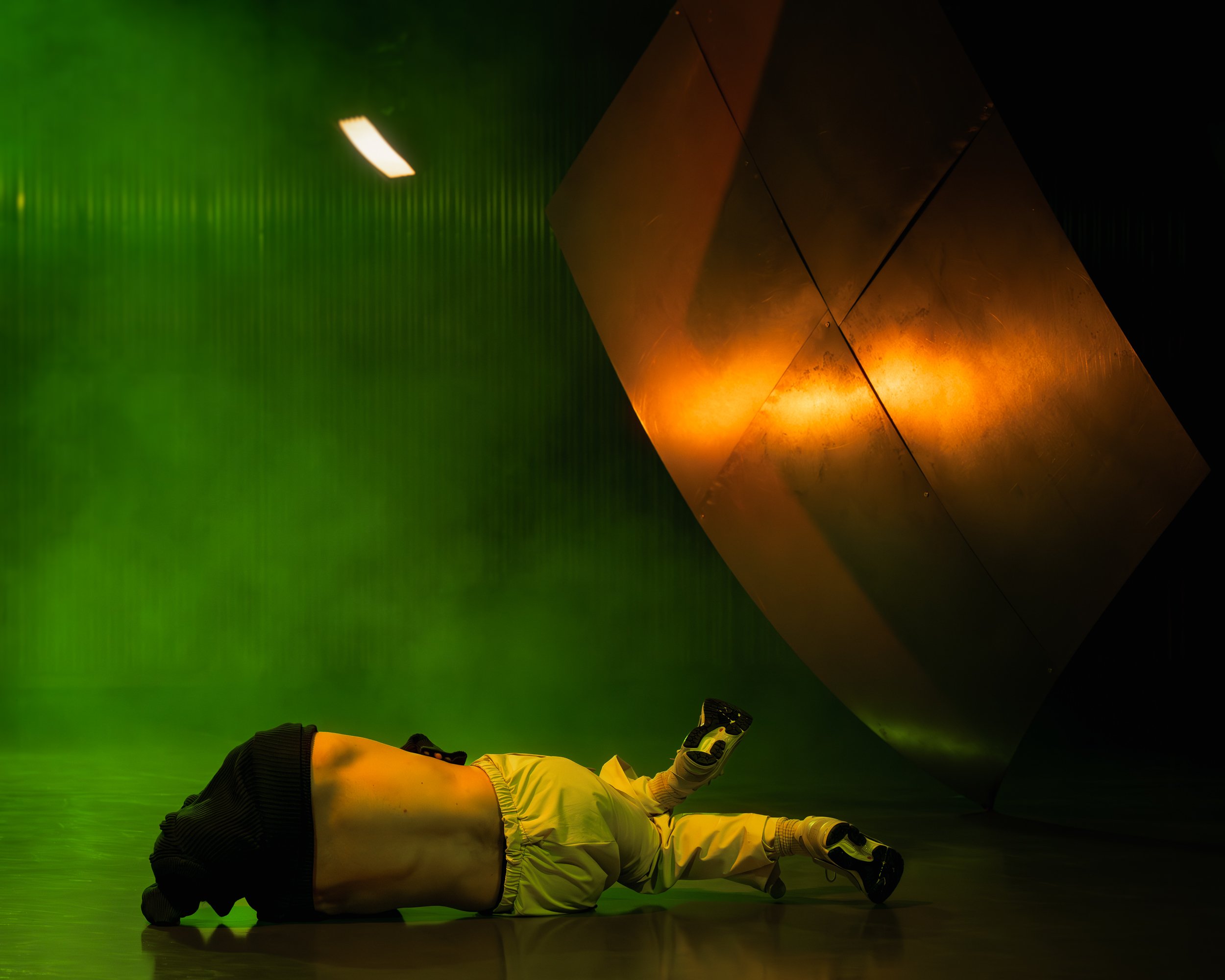
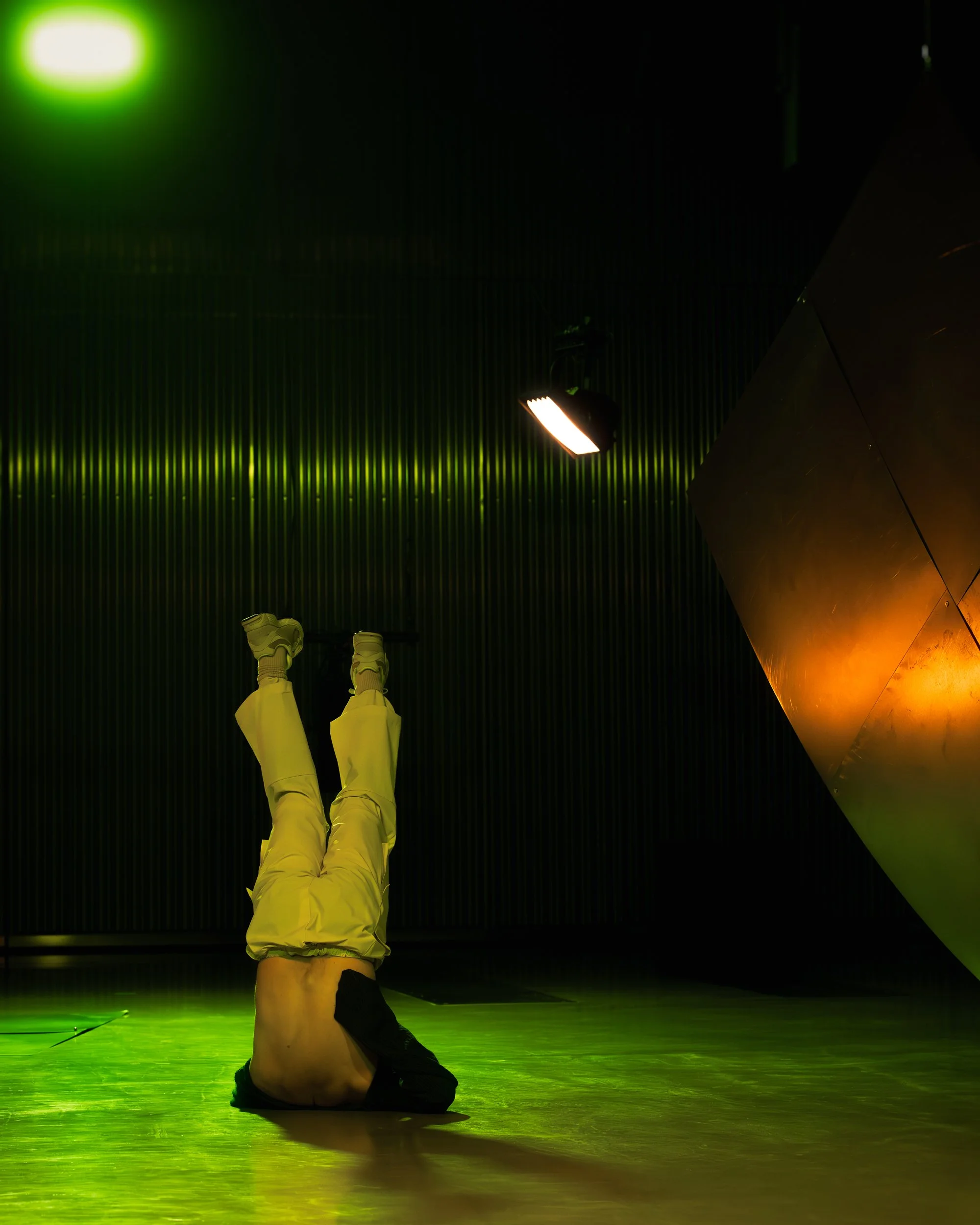
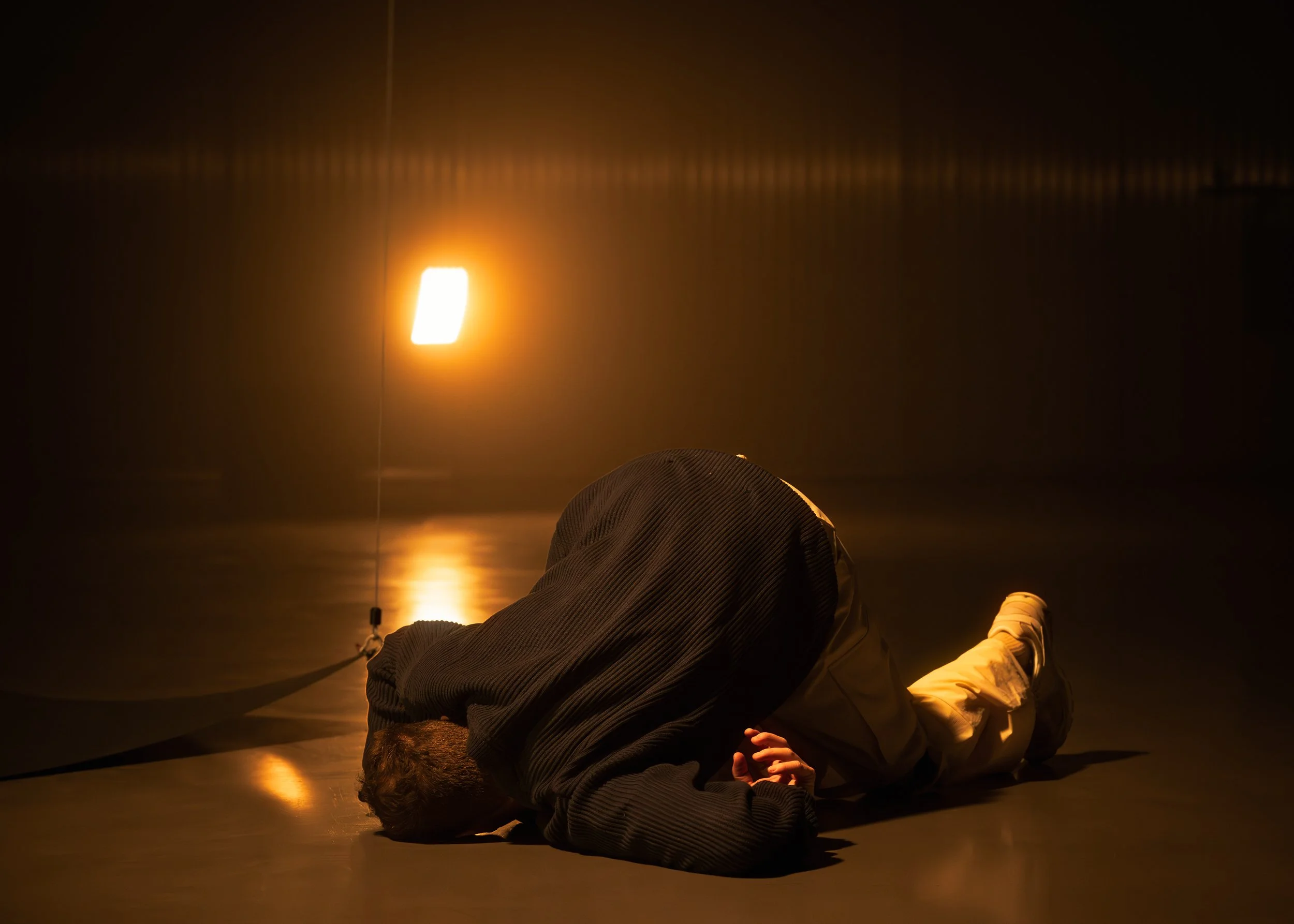
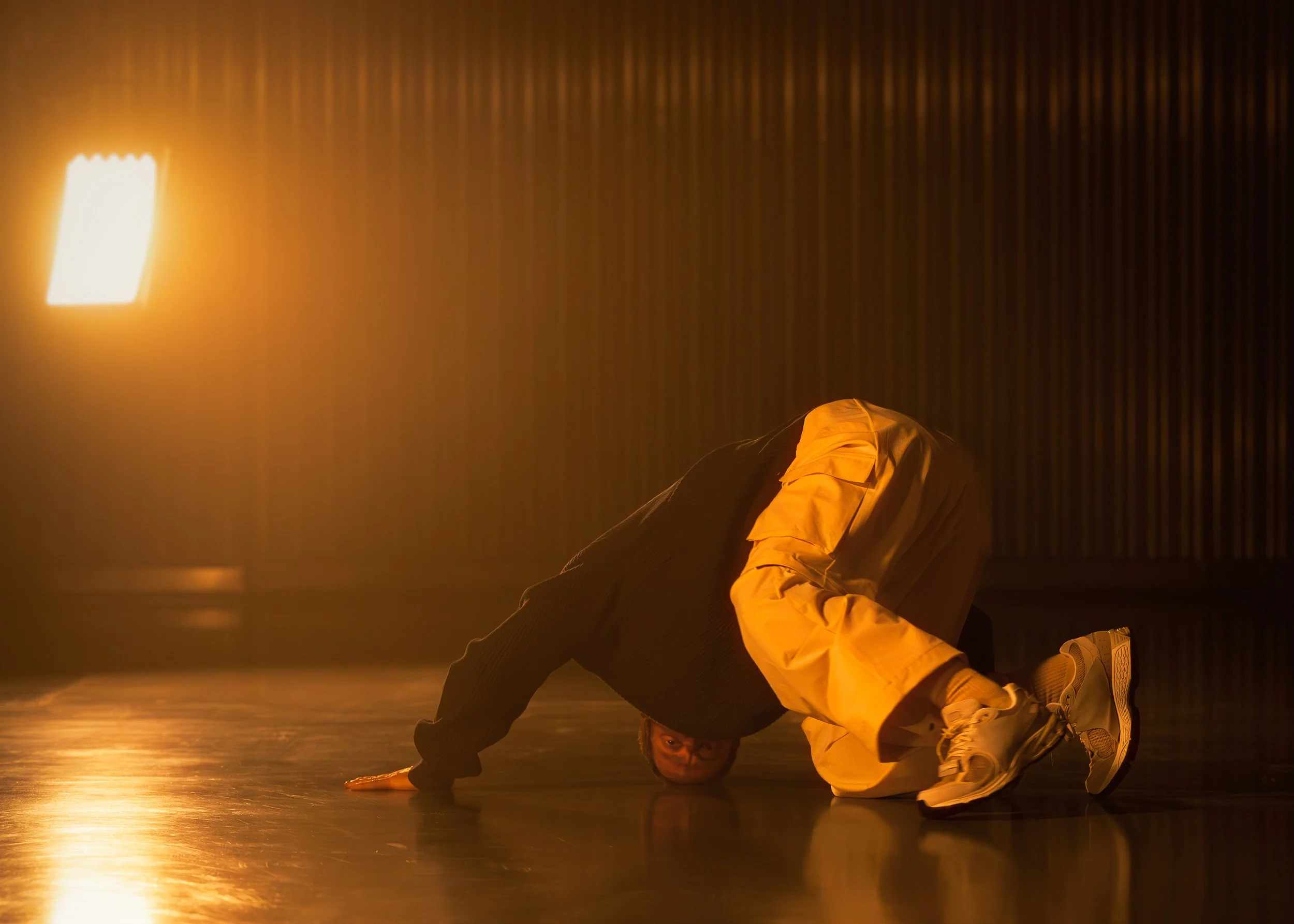
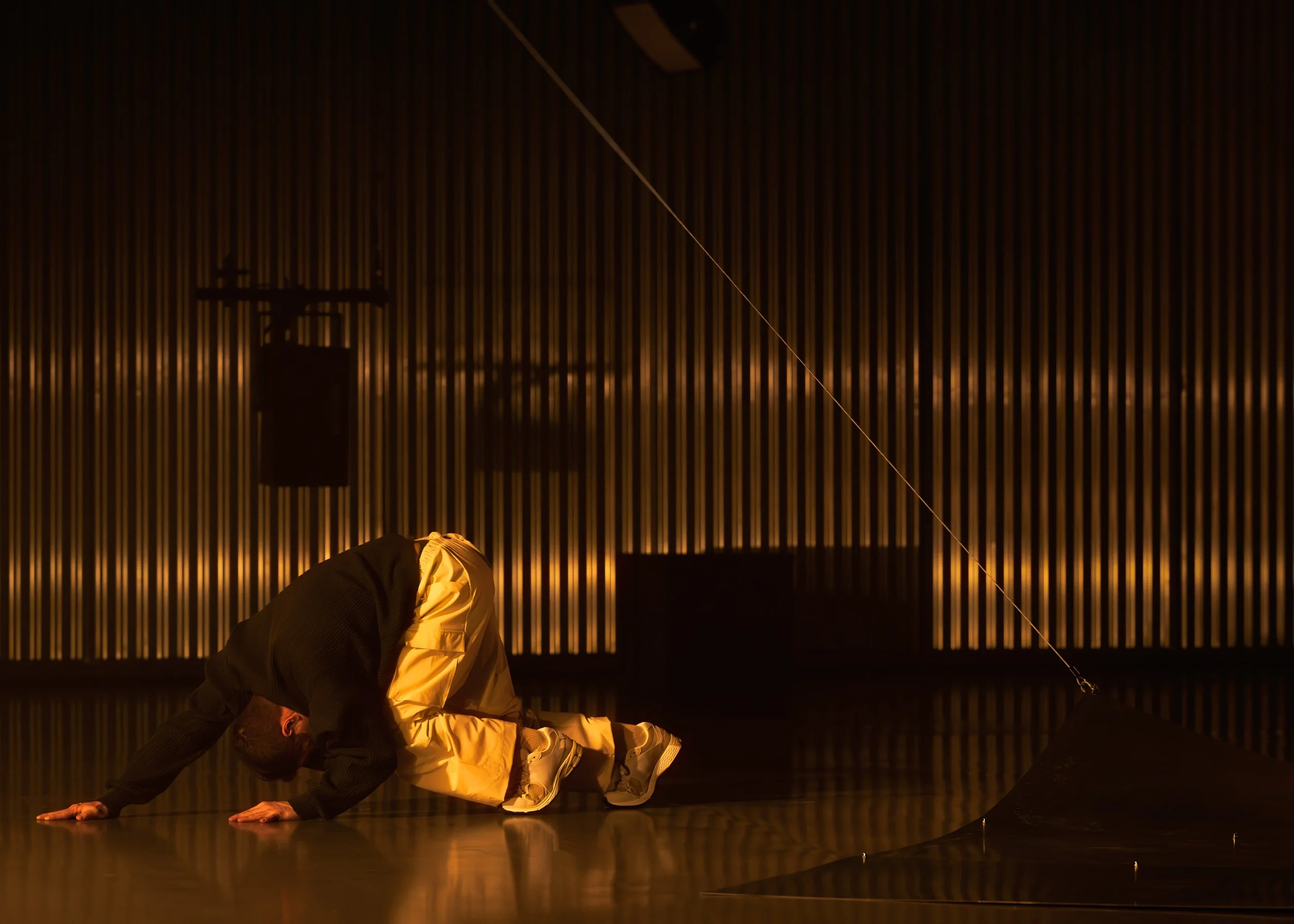
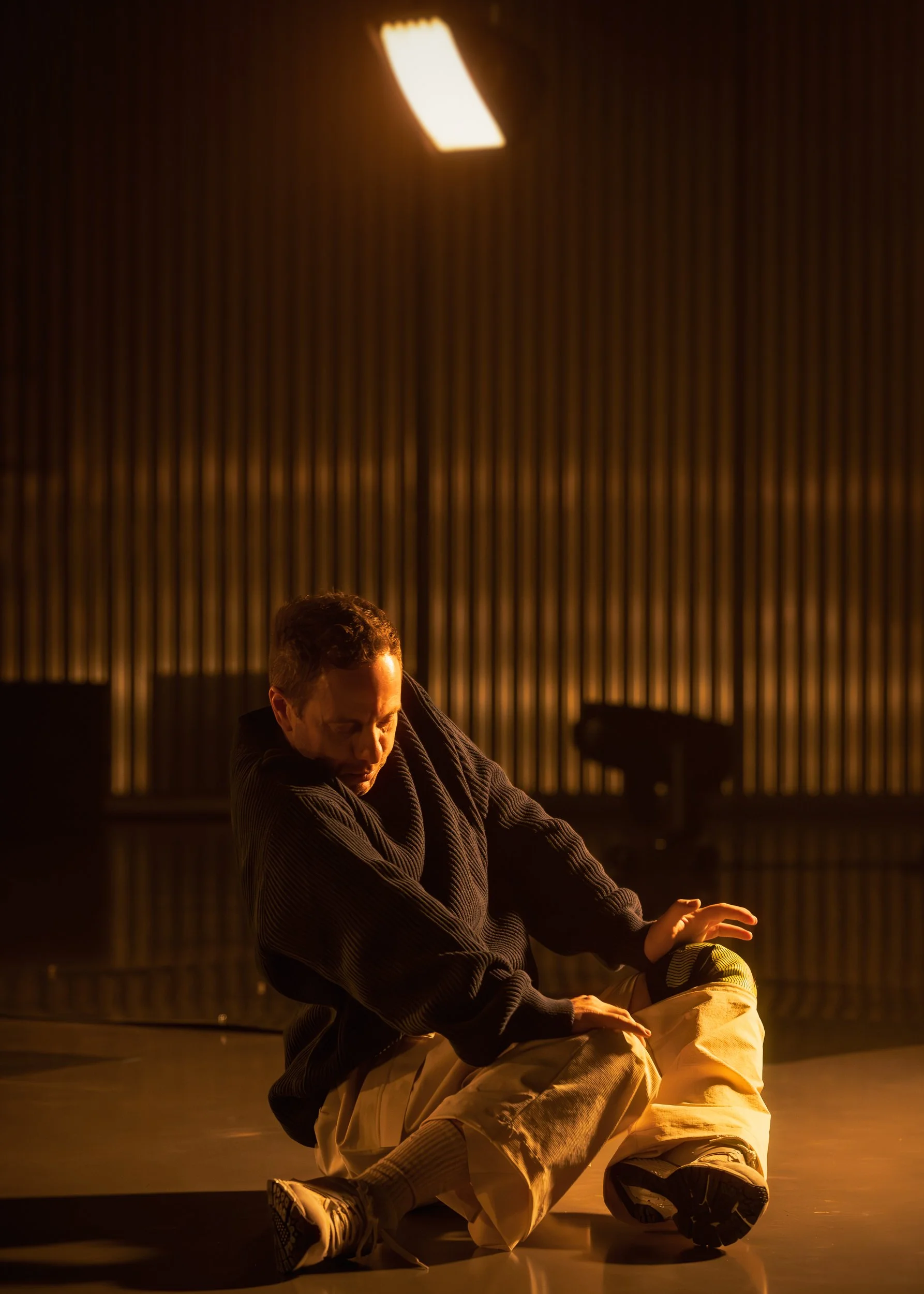
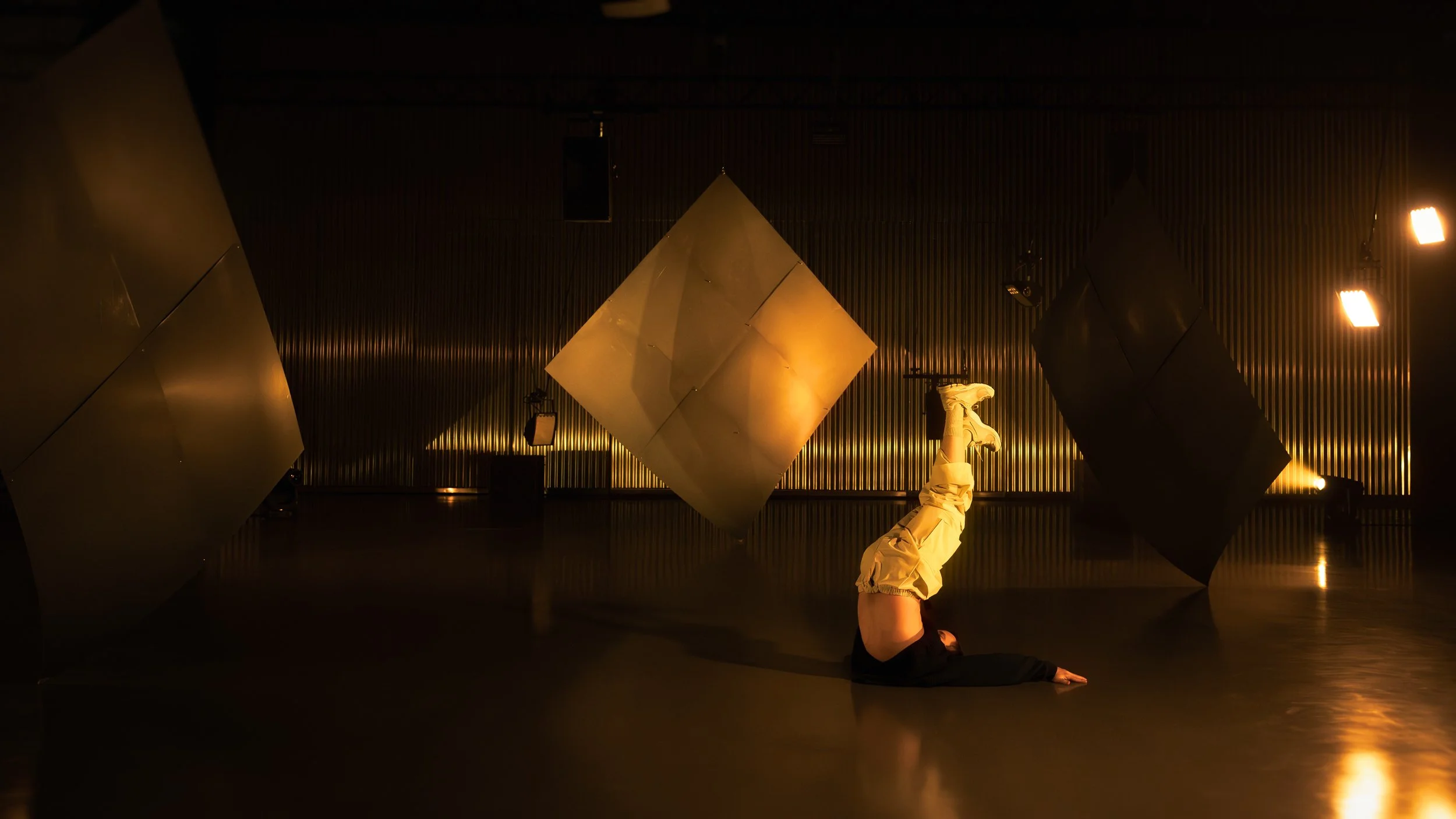
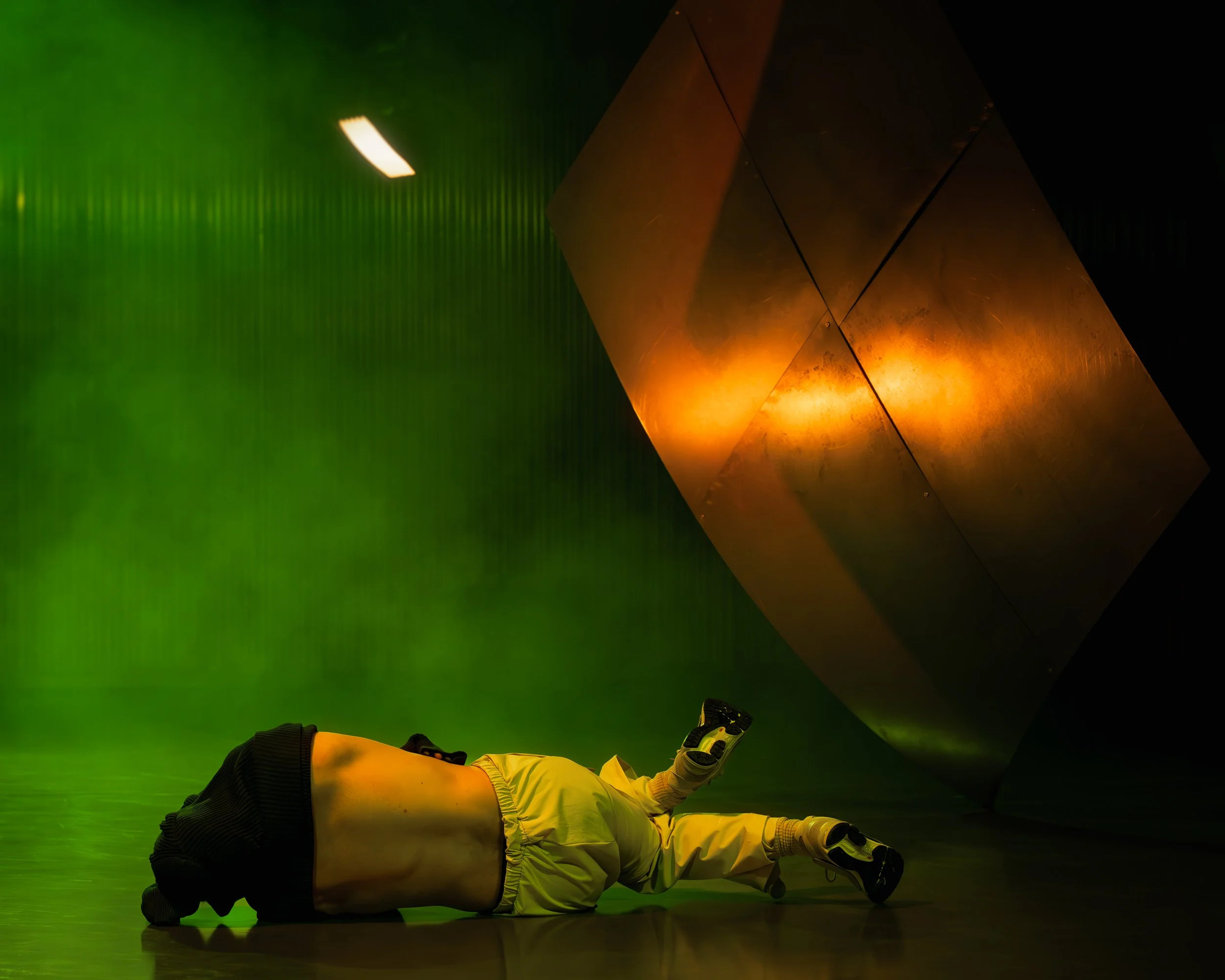
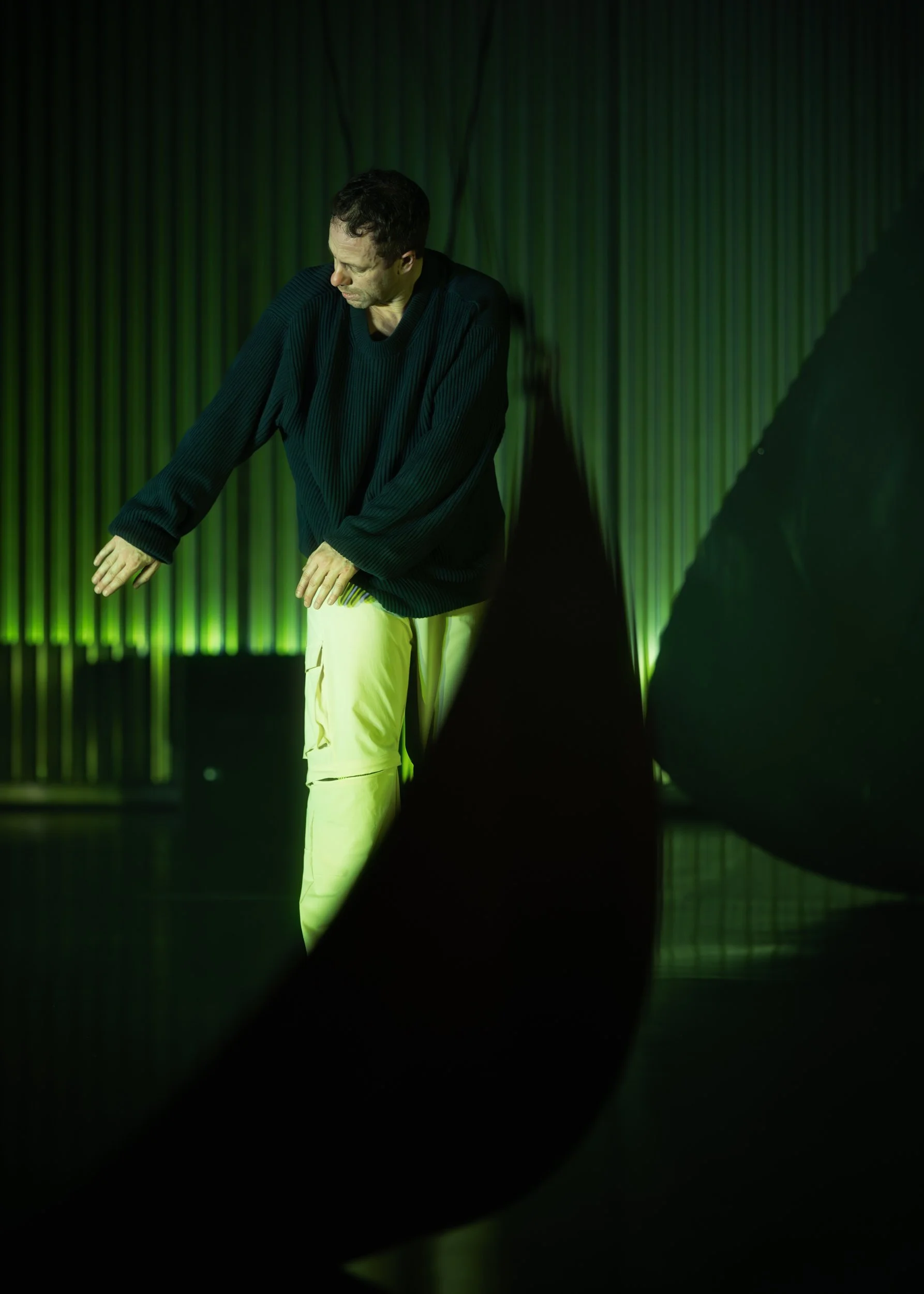
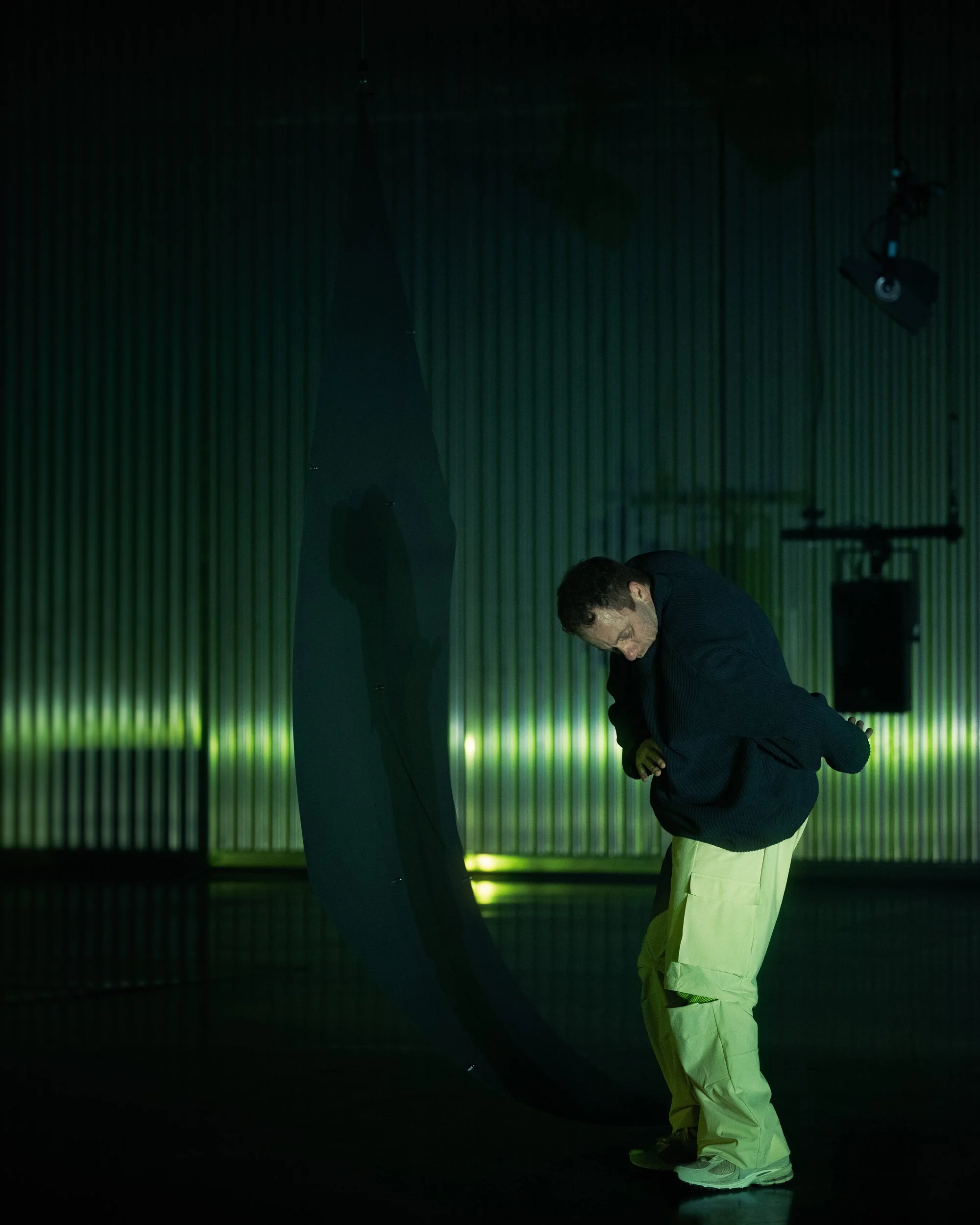
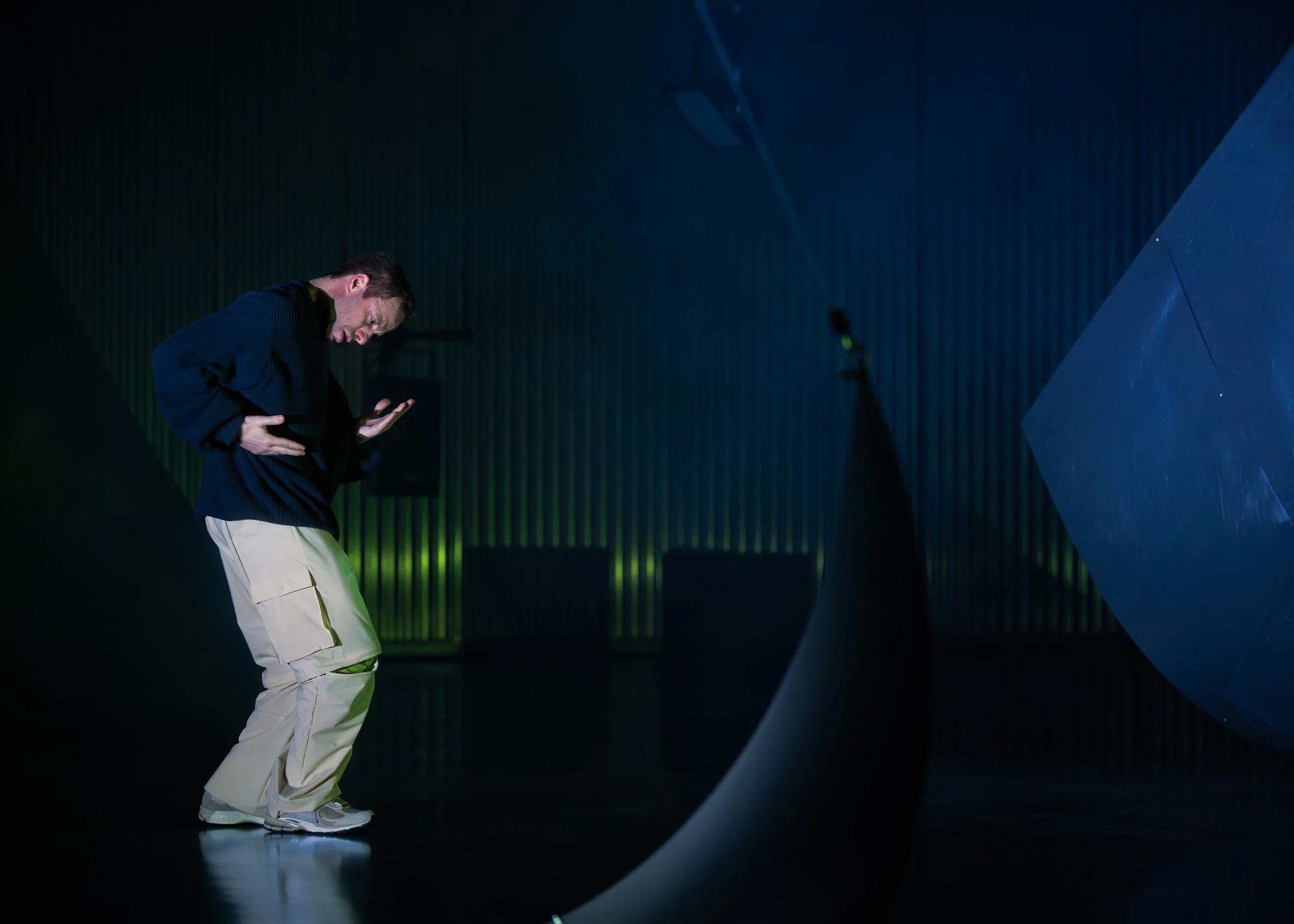
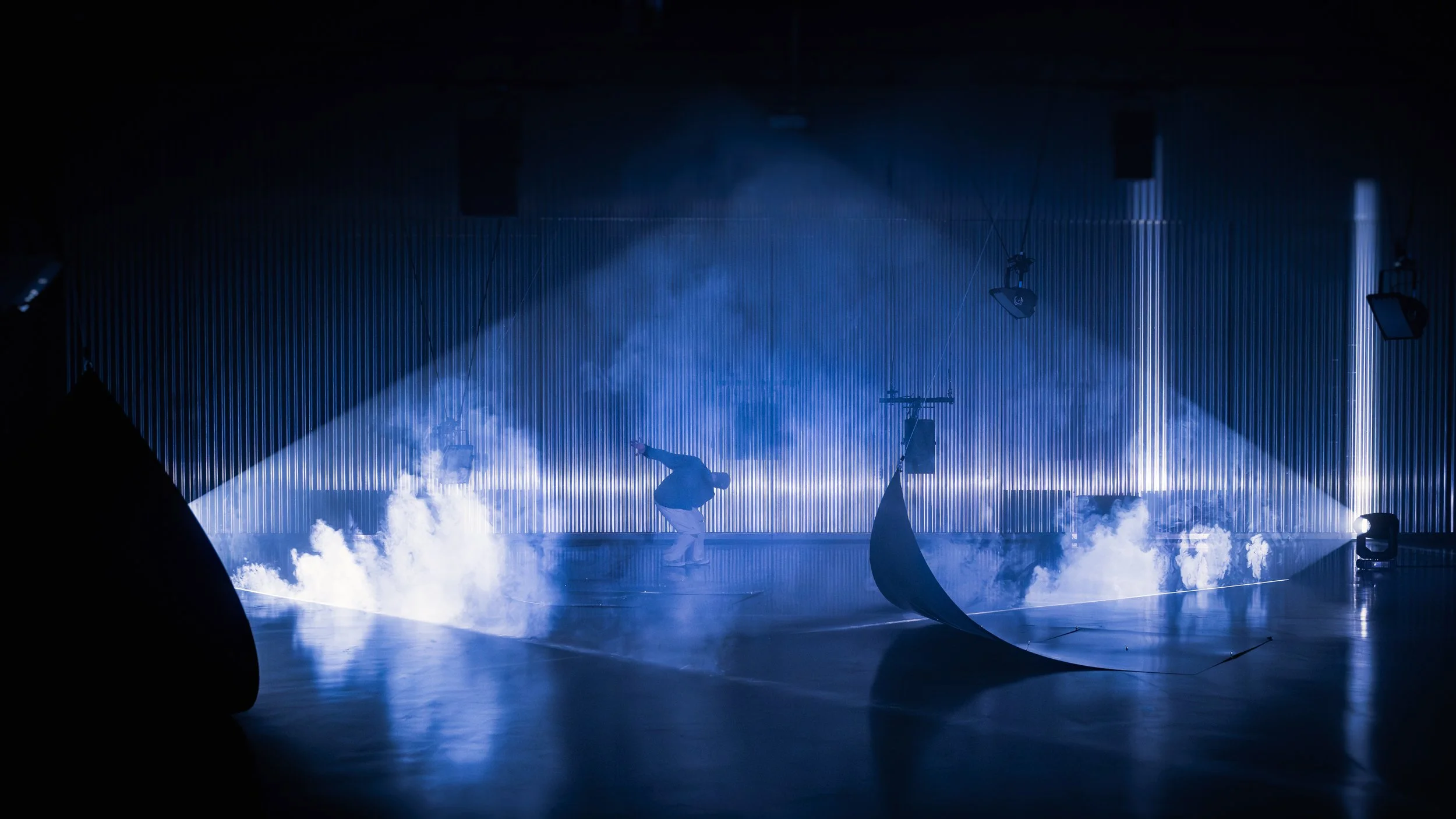
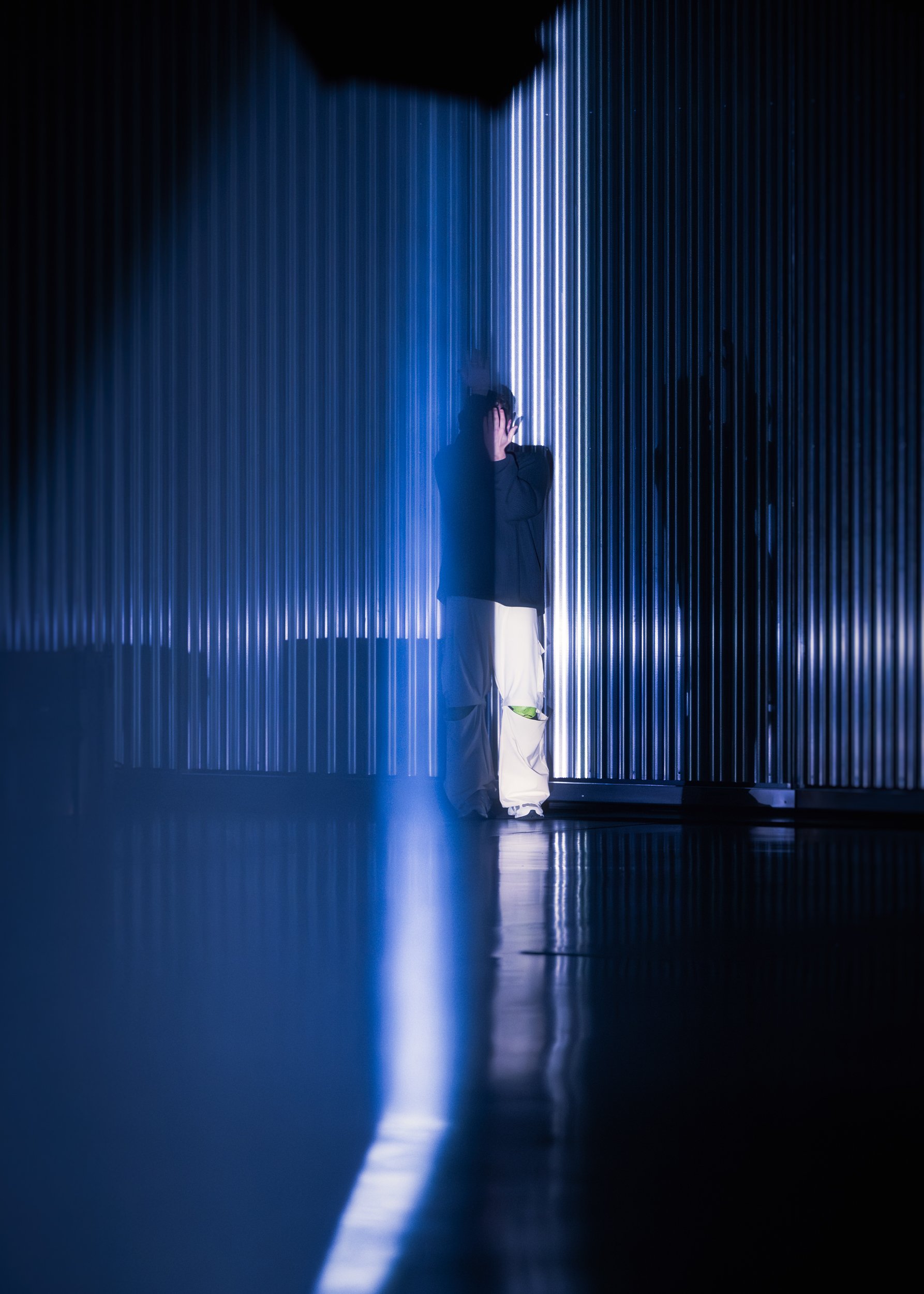
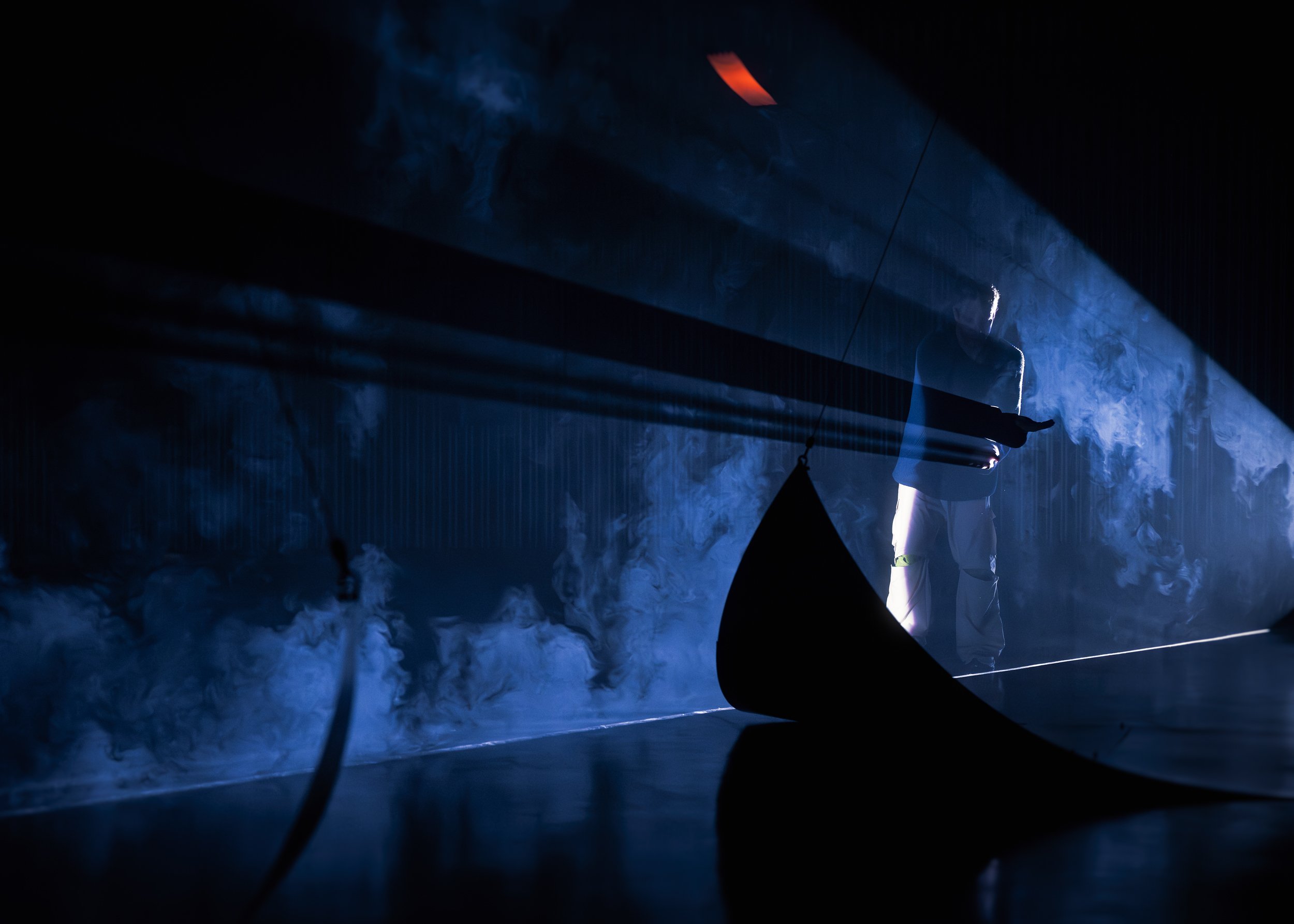
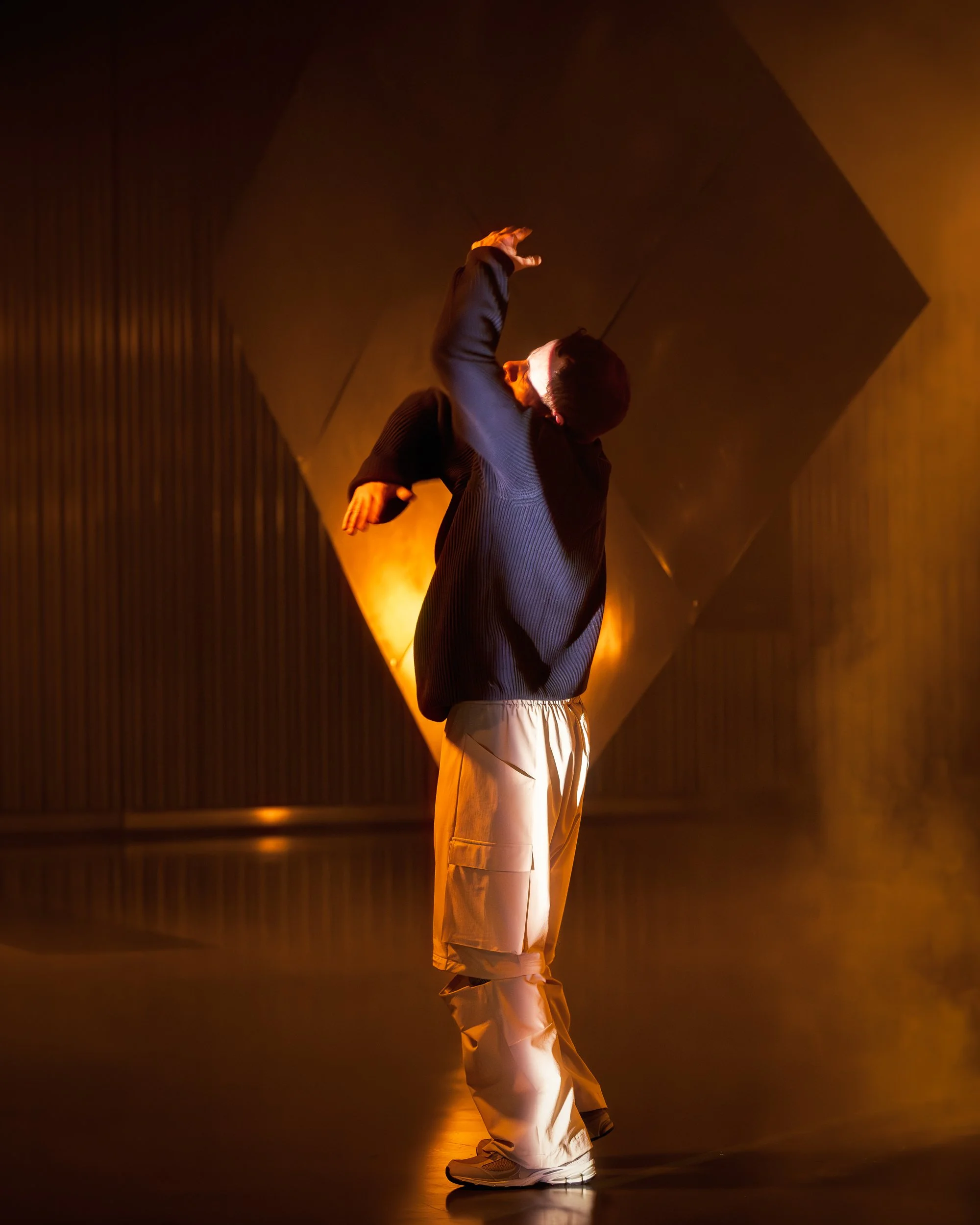
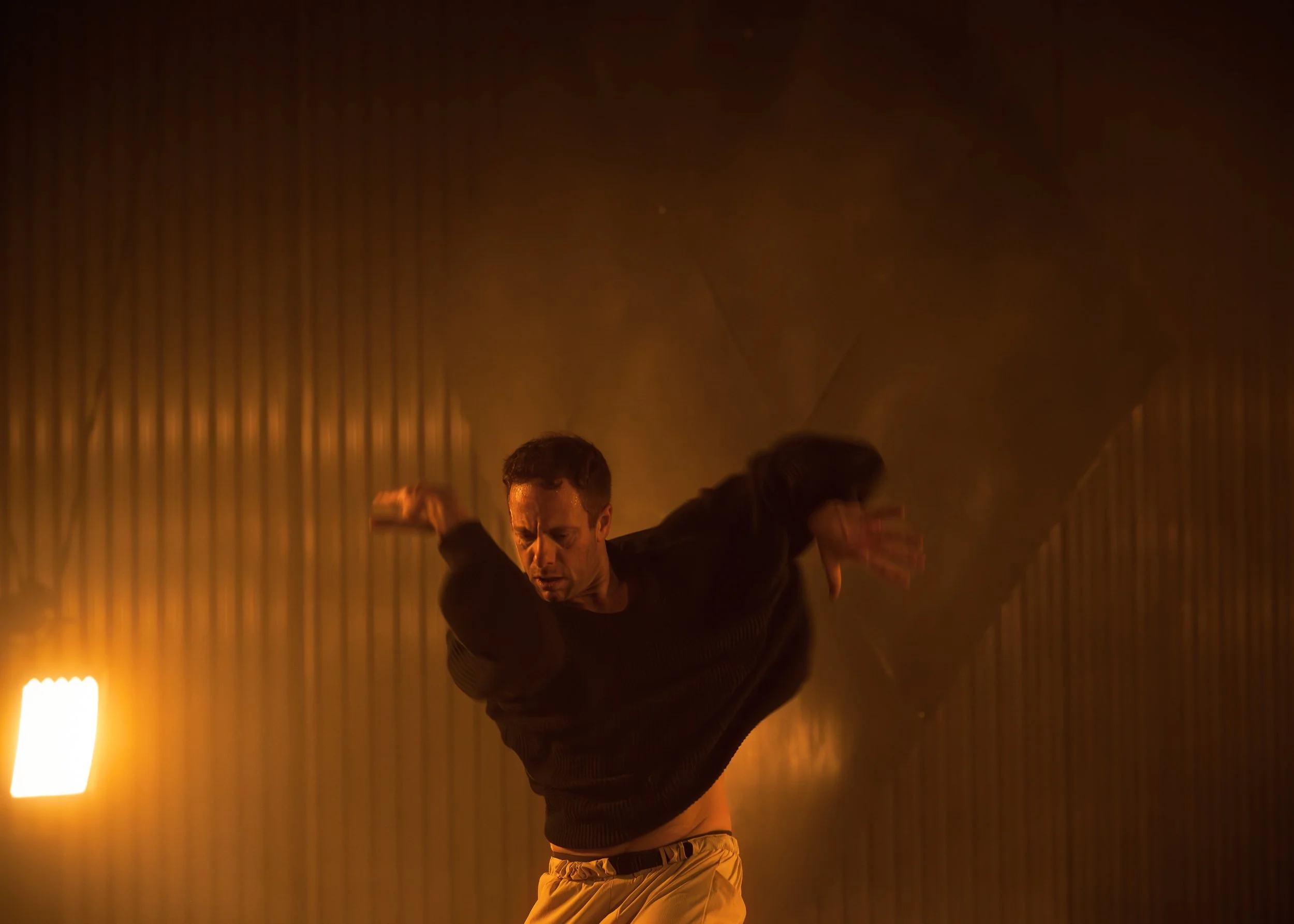
TECTONIC is a choreographic work on the seen and unseen forces that shape our world. Set in a kinetic landscape of suspended metal plates, the work situates the dancer’s body as part of a larger ecology of forces in motion. In tune with the deep vibrations of the earth, the body morphs through states of compression, release, friction, and gliding. Movement folds and unfolds—the dancer’s own geological layers uncovered as gravity and pressure negotiate with the ground.
Light saturates and empties, diffracts and reunites, and dissolves the space; metal plates rise and fall, hesitate, and resound. A sonic landscape merging field recordings and electronic textures generates a continuous atmospheric vibration, dissolving boundaries between body, materials and environment.
In TECTONIC, choreography unfolds through the relationships between body, metal, light and sound. Each brings its own capacities to move, resist, resonate and transform, shaping how the others are perceived. Attention shifts between them, revealing the dancer as both a source of movement and a body carried by forces beyond itself.
Through this interplay of human, nature and technology, TECTONIC invites us to perceive and move with the deep rhythms of the world, sensing our participation in transformations that exceed our scale, duration and control.
Photos by Thomas Zamolo
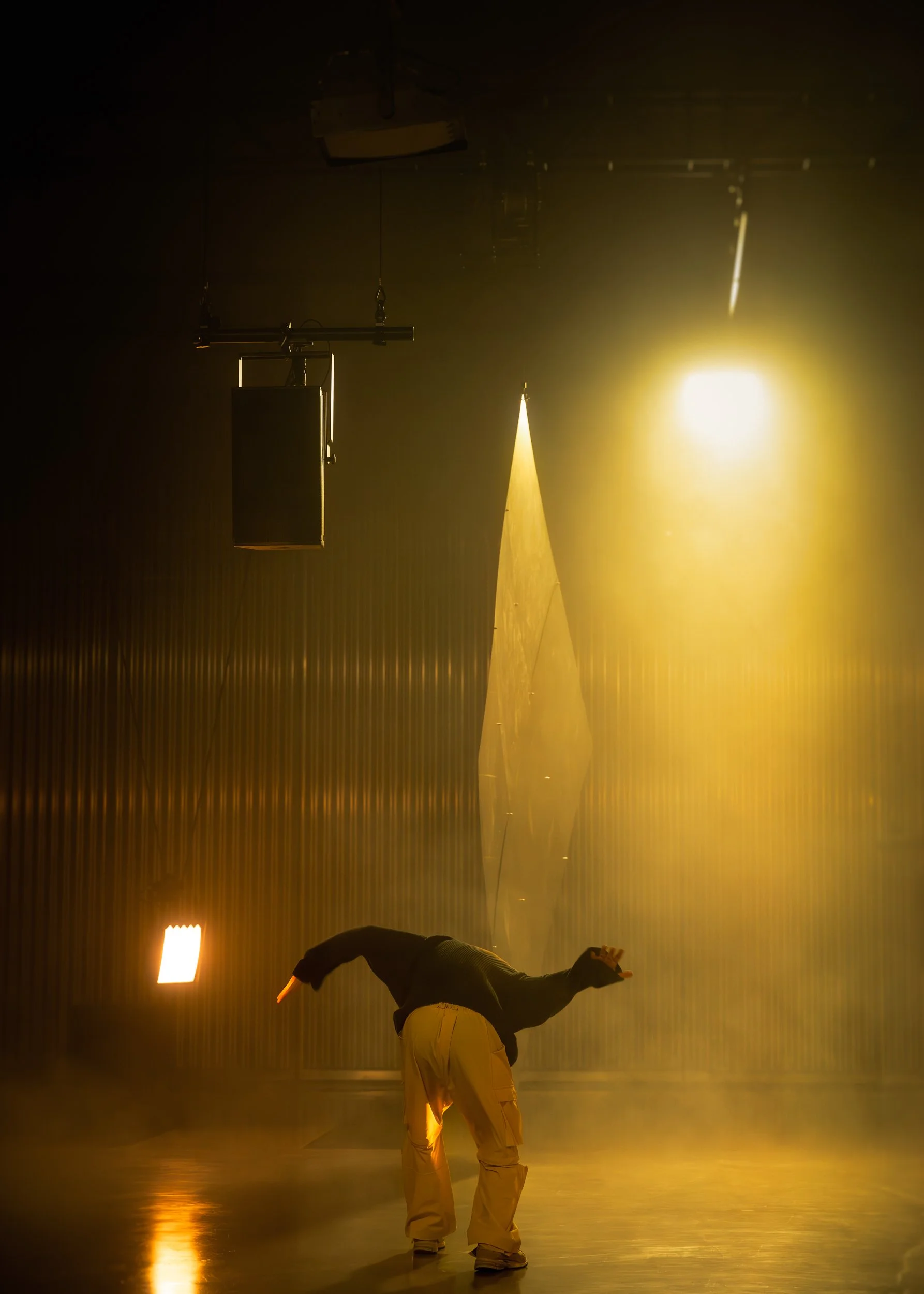
Concept, choreography, performance: Mirko Guido
Composer: Fredrik Arsæus Nauckhoff
Lighting design: Thomas Zamolo
Scenography, costume design: Olga Regitze Dyrløv Høegh
Metal plates kinetic choreography: Mirko Guido with Olga Regitze Dyrløv Høegh
Rehearsal director: Arika Yamada
Curatorial and artistic advisor: Linus Gratte
Dramaturgical sparring: Karen Lambæk
Thanks to: Elisa D’Amico, Tilman O’Donnell
Executive producer and company manager: Csongor Szabo
PR and Communications: Fabienne Pauly-Tanski
Co-production: Dansehallerne (Copenhagen, Denmark), Bora Bora (Aarhus, Denmark)
Residency partners: Åbne Scene/Godsbanen (Aarhus, Denmark), Milvus Artistic Research Center (Knislinge, Sweden), Dello Scompiglio (Lucca, Italy)
Supported by: Statens Kunstfond, Aarhus Kommune, Augustinus Fonden, William Demant Fonden, Beckett-Fonden, Aage og Johanne Louis-Hansens Fond, Wilhelm Hansen Fonden
Motion design equipment supported by: Wahlberg Motion Design
Production: Mirko Guido – Shifting Thoughts
“TECTONIC escapes traditional notions of dramaturgy or performativity: choreography, sound and light are treated as equal agents, creating a landscape to be experienced with all senses.”
“Guido plays with the subject/object perspective, awakening a quietly phenomenological one: the body experienced from within, while simultaneously appearing as part of a larger whole.”
“After the blackout, what remains is a tension between vulnerability and force. Something has shifted – beneath us, and within the room.”
Ingeborg Zackariassen, Springback Magazine
https://springback.org/magazine/2026/02/mirko-guido-tectonic
“TECTONIC is a sensory dance of geological forces that render us small and vulnerable atop the Earth’s crust. Mirko Guido’s solo performance generously surrenders to these forces on a human scale, amplifying nature’s slow rhythms and measured transformations—from the smallest repetitive movements to the violence unleashed when it finally erupts.”
“Art can awaken our ability to rediscover our senses and care, when someone like this has made the effort to listen to what the rest of us have long forgotten.”
Dorte Grannov Balslev, Iscene
https://iscene.dk/2026/01/31/tectonic-fascinerende-rejse-ind-i-jordens-rytmer/
“An encounter with the Earth’s inner core and the pulsating impact of energy on its physical layers. TECTONIC is a six-star experience.”
Lita Domino, Kulturnyt
https://kulturnyt.net/dans/anmeldelse-tectonic-bora-bora-aarhus/
“There is a subtle and effective interplay between dance, sound, light, and scenography in this carefully crafted, beautifully danced, and well-structured work exploring the forces and movements of the earth on both small and large scales.”
Vibeke Wern, Danstidningen
https://www.danstidningen.se/2026/02/01/tektoniska-krafter-och-rorelser/
“Mirko Guido’s dance performance TECTONIC is about the body and the world to which it is subject—about how the body and the Earth’s tectonic plates, in their perpetual displacement, have entered into an inevitable pact. Choreographer Mirko Guido’s minimalist movement language speaks directly to the beautiful, planetary scenography, in which large metal plates are alternately lifted, lie still, hum, or erupt in thunderous motion.”
“As an audience member, you really feel the world of forces that Guido lets his body act in (…) TECTONIC is truly a vibrating sensory experience.”
Casper Koeller, Sceneblog
http://sceneblog.dk/anmeldelse-tectonic-mirko-guido-dansehallerne-bora-bora/
A unifying theory:
notes on Tectonic by Mirko Guido
Linus Gratte
“The earth has not only its comprehensive system of growth, in which strata have been added to strata, continents and seas defined, mountains reared, and valleys, rivers, and plains formed, all in orderly plan, but also a system of currents in its oceans and atmosphere,— the earth's circulating-system; its equally world-wide system in the distribution of heat, light, moisture, and magnetism, plants and animals; its system of secular variations (daily, annual, etc.) in its climate and all meteorological phenomena.”
This essay deals with the dance performance Tectonic but, let’s take ourselves back to before the designated choreographic event begins. Long before the light dims and projectors go on, before entering the theatre, in fact, earlier still: prior to rehearsals and composition, to open calls and applications, before the building was constructed, before plans were made and resources were allocated.
Before, after, and simultaneously to the dedicated artistic work, we participate in another performance. One that has been conducted for unfathomable swaths of time, over stretches of space undefinable, encompassing, embracing, and non-judgmental. That moves you, and makes you move, and moves you forward. Ever spinning webs of interacting dynamic resistance. You are pulled towards as you are pushing against and vice-versa.
The ground is not still. The center does not hold. Such is the prerequisite of the new dance work Tectonic by Mirko Guido. It does not posit geology and dance as two antagonistic entities. It does not contrast the littleness, frailty, flesh of the dancer, to the vastness, immutability and minerality of the earth; nor volatility and freedom of will with fixedness and subjugation. Rather, it examines a grand relation of terrestrial beings and events — of which the choreographic work is, at once, a part, as it draws our attention to it. Simultaneously, Tectonic invites us to accept a loss of control, while heightening our awareness, attuning to our surroundings in all directions: above, underneath, around, and within.
“…Geology treats of the earth in this grand relation…”
Plate tectonics describe the large-scale motion of the Earth’s crust. These enormous plates — spanning over hundreds of kilometers — operate at a scale and with a movement defying our everyday perception. As much as it eludes our human sense, earth is not a still life, a static canvas given to us as such. Given enough time, the world as it is today will be profoundly transformed and structurally different. By adapting our sense of scale, and how we choose to perceive this temporality; by entering geological time, we can see how all the characteristics of a landscape is shaped by endless and ongoing processes. The visual idiosyncrasies, even expressive qualities of each hill and valley, down to the characteristics of each rock and pebble, are not given as an immanent fact, but produced in an ongoing event.
The meaning of movement in Tectonic emerges not from the dancer’s subjective intent alone, but from the ongoing entanglement of bodies, matter, and forces—human and more-than-human. In this sense, Tectonic enacts an "elemental cinema": where the distinctions between subject and environment, human and geologic, are continuously destabilized. Just as geological structures are produced through time, pressure, and erosion, dance here is not a frozen representation of form but a processual unfolding, shaped by interactions with forces that exceed individual control. Denise Ferreira da Silva speaks about a political-ethical sensorium that illuminates how perception itself is conditioned by relationality. In Tectonic, attention is directed to the co-constitution of movement and environment through the entanglement from which they emerge. This collapses the distinction between, micro-temporal experience and geological time.
“Geology is sometimes defined as the science of the structure of the earth. But the ideas of structure and origin of structure are inseparably connected, and in all geological investigations they go together.”
Geology, emerging as a modern scientific field around the turn of the 19th century, was given the task of making sense of the history of the earth. Furthermore, geological proof enabled geographical claims: it granted a scientificness of the idea of land division and of extracting resources from it. As a discipline, geology was submitted to the optics of the exhibition: an apparatus of modernity to organize our visible world into modes of knowledge. Divided into taxonomies, presented as individual representatives, isolated in exhibit displays, carefully lit, “earth” is broken down into discrete components to be(?) drawn upon for scientific inquiry.
Dance as an art form, on the other hand –– obeying its own visual regime, a bright stage in the middle of the dark and silent theatre –– was historically defined by its separation from everyday life. its otherness to the rest of existence — whether in the service of narrative, symbolical or moral duty, or yet in the modernistic conception, as a separate substance. Tectonic breaks with the conception of dance as a tool of pure subjectivity, as an instrument of raising above the horizon. On the contrary, movement yields to gravity, to pressure, to erosion. Form arises from constraint, movement is shaped by forces larger and older than the self. Meaning emerges from contact, not from representation. And like the Earth, the body remembers through strata.
With the dance piece Tectonic, Mirko Guido shows how dance can acknowledge these processes in a meaningful way. Our perceptual and phenomenological capacities allow us to interact with this world, and so these interactions leave their mark on the body of the dancer, orient their continued wandering throughout existence. The meaning is not performed but deposited — layered through repetition, weight, and contact with the ground. The sedimentation layers of the geological past are also here understood as the cumulation of past experiences. Past stress on the body prompts new ways of negotiating movement, as earthquakes occur where plates remember past collisions. The body becomes a site of compression and release, a temporary fault line through which the earth continues its slow, indifferent choreography. Yet, certain parts are more prone to tremor or breaks.
And so, this work builds on to previous embodied experiences of the artist: the continuous and repeated practice of dancing and other activities, over decades, for others, for himself, paid or unpaid, in company or alone. As such, the notions chosen by the artist — divergence, convergence, and lateral sliding, grinding, and states such as friction, tension, resilience, collapse, and emergence — take on new somatic and choreographic meanings. Through the stratigraphic marking of the body, these events are not represented, but referenced.
In preparing the work, the choreographer together with composer Fredrik Arsæus Nauckhoff conducted a field trip to Iceland, to the specific divergent plate boundary where two continental plates drift further apart each year. Choreographic embodied ideas evolved with the observation of nature. Field recordings of sounds produced by the landscape can be heard in the performance.
“In using the present in order to reveal the past, we assume that the forces in the world are essentially the same through all time; for these forces are based on the very nature of matter, and could not have changed.”
As with earlier works All That Remains or The Longest Gap, the core of Mirko Guido’s practice lies the realization that dance is not an isolated, hermetic system, rather situated itself in a dynamic system. It realizes that dance is not the will to impose a narration, illustrate a symbolic notion or instill a virtue, rather a way of attuning to underlying forces the precede us, follow us and surround us.
And still, it is not an imperative to subjugation or abandonment, a simple inversion of the dominance hierarchy where “nature” dictates to a human subject. Within these ecologies, emotions, resilience, creativity, endeavor, empathy, carve out their place and impel new meanings and contexts.
Tectonic’s ethics and methods resonate strongly with a lineage of dance and performance that treats the body not as an abstract form-maker, but as a listening instrument for the earth. Choreographers such as Anna Halprin replaces imposed choreography with scores that attune attention downward: to weight, to contact, to sensation, to the micro-rhythms of walking, lying, circling.
Yet, far from a puritan return to nature, the scenic apparatus of Tectonic admits its place in a reality marked by man-made and technological features. Rather, it invites both light –– shifting and intense, geometrical and contemplative at turns –– and objects –– large metal plates that in turn rise and fall, hesitate and come forth –– to become part of a larger actor-network. And so, in this laboratory, known and unknown forces come together to orchestrate events. Long and slow processes erupt into sudden bursts.
French philosopher and dancer Emma Bigé, in her exploration of the multitude of forces moving the creatures of Earth, points to intermediary grammatical modes of certain languages such as ancient Greek, eluding the binary opposition of the active and the passive: as we are moving and being moved at the same time.
In a world overwrought with self-consciousness, the liberation of a crushing sense of subjectivity, to consider ourselves as an embodied agency among others, is emancipatory. The body becomes our tool and instrument of assessing and sharing this knowledge. The performance does not ask us to conceive of these terrestrial and forces as fatalistic, or oppressive but as an open invitation to partake in the world.
“New crust is continually being pushed away from divergent boundaries where sea-floor spreading occurs. But the Earth isn’t getting any bigger.”
(Quotes in italics are from Manual of geology, treating of the principles of the science, 1874, James D. Dana)